
Deze gratis online maankalender is handig voor iedereen die de maanfasen van Juni 2015 wil zien. De eerste dag van deze maand begint met de fase . Dankzij de maandelijkse maanfasenkalender kun je ook de exacte data van volle maan, nieuwe maan, eerste kwartier en laatste kwartier voor Juni 2015 bekijken. Bezoek ook de maanfasenkalender van 2015 om alle dagelijkse maanfasen van dit jaar te zien.
Juni 2015
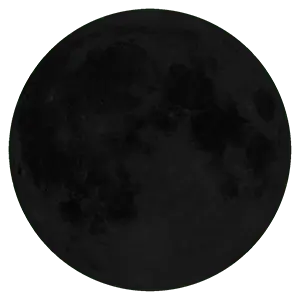
Nieuwe maan
Dit is de eerste en onzichtbare fase van de maan, waarbij de verlichte zijde naar de zon is gekeerd en de nachtzijde naar de aarde. De nieuwe maan is alleen direct zichtbaar tijdens een zonsverduistering.
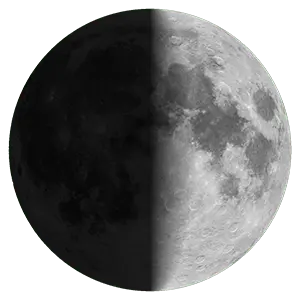
Eerste kwartier
Een week na nieuwe maan volgt het eerste kwartier, wanneer de maan een kwart van haar baan heeft afgelegd. Het wordt ook wel halve maan genoemd. Een maan in het eerste kwartier komt rond het middaguur op en gaat rond middernacht onder.
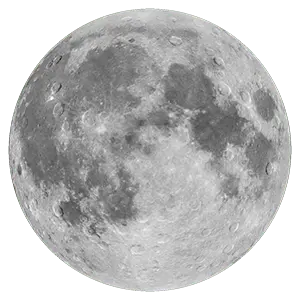
Volle maan
Bij 100 % verlichting is de dagzijde van de maan recht naar de nachtzijde van de aarde gericht en is de maan vol. Een volle maan komt op bij zonsondergang en gaat onder bij zonsopkomst, en lijkt groter nabij de horizon.
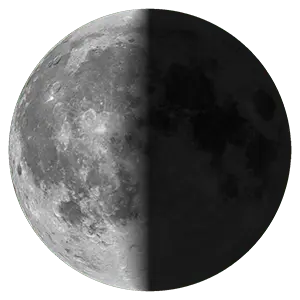
Laatste kwartier
De maan komt in het laatste (derde) kwartier van haar baan op een leeftijd van bijna 23 dagen. Slechts de helft lijkt verlicht. Deze fase is laat in de nacht en in de vroege ochtend (rond 6 uur) te zien.
A supermoon occurs when the Moon's orbit is closest (perigee) to Earth at the same time the Moon is full. At such a time, the Moon can look larger and brighter than it normally does - especially when it is seen rising above the horizon. However, it's important to note that the actual difference in size and brightness between a supermoon and an average full moon is not typically dramatic, and may not be noticeable to the naked eye without a direct comparison.
Meer MaanfeitenAn orange moon means the shorter wavelengths of light are being filtered away. This could be due to the low position on the horizon causing the light to go through more atmosphere, smoke in the air, or pollution.
Meer MaanfeitenThis is an optical illusion. The Moon looks large shortly after it rises when it's still touching the horizon. This is not the same as a Supermoon.
Meer MaanfeitenAn analysis of moon's mineral composition suggests that the moon is around 4.425 billion years old.
Meer MaanfeitenA "micromoon" is a term used in popular astronomy to describe a full moon or a new moon that occurs when the moon is at or near its apogee, which is the furthest point from Earth in its elliptical orbit. This is the opposite of a "supermoon," which occurs when a full moon or new moon is at or near its perigee, which is the closest point to Earth in its orbit."
Meer MaanfeitenThe Moon is the fifth largest satellite in the Solar System and the biggest in comparison to its host planet, with a diameter about one-quarter that of Earth. The exact diameter is 2159.14 miles (3 474.8 km ).
Meer MaanfasenThis is an optical illusion. The Moon looks large shortly after it rises when it's still touching the horizon. This is not the same as a Supermoon.
Meer MaanfasenNo, it doesn’t generate its own light. “Moonlight” is really sunlight that has reflected off of the Moon’s surface. In the same way that the Sun illuminates Earth, the Moon reflects the Sun's light, making it appear bright in our sky.
Meer MaanfasenAn analysis of moon's mineral composition suggests that the moon is around 4.425 billion years old.
Meer MaanfasenA supermoon occurs when the Moon's orbit is closest (perigee) to Earth at the same time the Moon is full. At such a time, the Moon can look larger and brighter than it normally does - especially when it is seen rising above the horizon. However, it's important to note that the actual difference in size and brightness between a supermoon and an average full moon is not typically dramatic, and may not be noticeable to the naked eye without a direct comparison.
Meer MaanfasenNo, the moon has no water and has only a very thin and tenuous atmosphere (called an exosphere) so it cannot trap heat or insulate the surface. So, for example, there is no wind to create weather system. The Moon does, in fact, affect the Earth's climate and weather patterns in several subtle ways.
Meer Leuke feitenIt depends on the time of day. The Moon is very hot in the daytime and very cold at night. The average temperature on the Moon varies from -298 degrees Fahrenheit (-183 degrees Celsius), at night, to 224 degrees Fahrenheit (106 degrees Celsius) during the day.
Meer Leuke feitenAn analysis of moon's mineral composition suggests that the moon is around 4.425 billion years old.
Meer Leuke feitenThe Moon crust is made of composed primarily of oxygen (O), silicon (Si), magnesium (Mg), iron (Fe), calcium (Ca), and aluminum (Al), but important minor and trace elements such as titanium (Ti), uranium (U), thorium (Th), potassium (K), and hydrogen (H) are present as well. Below the crust is the mantle coming, with a thickness of roughly 1350 km is far more extensive than the crust, which has an average thickness of about 50 km. The mantle is made of olivine, orthopyroxene and clino pyroxene. Finally, at the center is the Moon’s dense, metallic core. The core is largely composed of iron (Fe) and some nickel (Ni). The inner core is a solid mass of about 480 km in diameter. Surrounding the solid inner core is a fluid outer core, that brings the total diameter of the core to about 660 km.
Meer Leuke feitenAn orange moon means the shorter wavelengths of light are being filtered away. This could be due to the low position on the horizon causing the light to go through more atmosphere, smoke in the air, or pollution.
Meer Leuke feiten






MoonPhaseToday.org laat je de maanfase voor vandaag en vannacht zien, of voor een willekeurige dag, maand en jaar. De berekening van de maanfase is gebaseerd op je tijdzone, maar we tonen ook de exacte tijden in UTC-formaat. We hopen dat je onze tool nuttig en gebruiksvriendelijk vindt om de maanfasen te bepalen.
MoonPhaseToday.org