
De huidige maanfase voor vandaag en vannacht is de Afnemende maansikkel. De maan is nu voor 3.8 % verlicht en is afnemend. Vandaag is de maan 27.7 dagen oud.
De geschatte afstand van de aarde tot de maan is 381,430, en er resten nog 1.8 dagen tot de volgende fase – (Nieuwe maan).
Bezoek ook de Oktober 2026 Maanfasen kalender om alle dagelijkse maanfasen voor deze maand te zien.
Huidige tijd: 11.15.
Het paneel hierboven toont de maanfase van vandaag, samen met de verlichting, leeftijd en afstand tot de aarde, berekend voor jouw tijdzone en in UTC. De Maan bevindt zich ergens in haar cyclus van 29,5 dagen tussen nieuwe maan en volle maan, en die fase is voor iedereen op aarde hetzelfde — alleen de exacte lokale tijd verschilt.
Vanaf hier kun je de maanfase voor elke datum opzoeken, een maandelijkse of jaarlijkse maankalender openen, aftellen naar de volgende volle maan en komende supermanen, micromanen en eclipsen vinden. Alles wordt live berekend uit nauwkeurige astronomische formules — gratis en zonder aanmelding.

Maanfase vandaag: Afnemende maansikkel
Vorige fase: Laatste kwartier ()
Afstand tot de maan: 381,430 km
Verlichting: 3.8 %
Maanleeftijd: 27.7 dagen
Volgende fase: Nieuwe maan ()
Hoekgrootte van de maan: 0.52
Afstand tot de zon: 149,462,572 km
Sterrenbeeld van de maan: Maagd

2026-09-11 – 2026-10-10
| Maanfase | DATUM EN TIJD |
DATUM EN TIJD (UTC) |
|---|---|---|
| Nieuwe maan | ||
| Eerste kwartier | ||
| Volle maan | ||
| Laatste kwartier | ||
| Nieuwe maan |
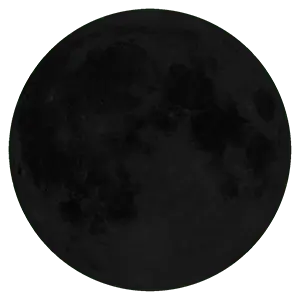
Dit is de eerste en onzichtbare fase van de maan, waarbij de verlichte zijde naar de zon is gekeerd en de nachtzijde naar de aarde. De nieuwe maan is alleen direct zichtbaar tijdens een zonsverduistering.
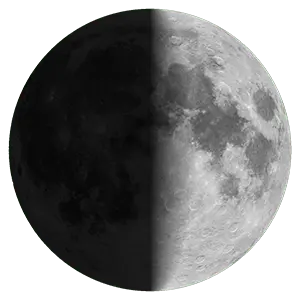
Eerste kwartier
Een week na nieuwe maan volgt het eerste kwartier, wanneer de maan een kwart van haar baan heeft afgelegd. Het wordt ook wel halve maan genoemd. Een maan in het eerste kwartier komt rond het middaguur op en gaat rond middernacht onder.
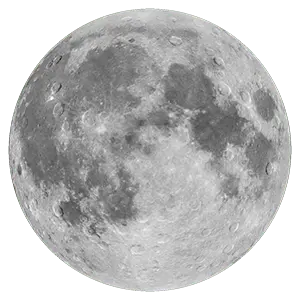
Volle maan
Bij 100 % verlichting is de dagzijde van de maan recht naar de nachtzijde van de aarde gericht en is de maan vol. Een volle maan komt op bij zonsondergang en gaat onder bij zonsopkomst, en lijkt groter nabij de horizon.
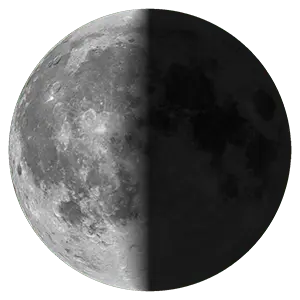
Laatste kwartier
De maan komt in het laatste (derde) kwartier van haar baan op een leeftijd van bijna 23 dagen. Slechts de helft lijkt verlicht. Deze fase is laat in de nacht en in de vroege ochtend (rond 6 uur) te zien.
A supermoon occurs when the Moon's orbit is closest (perigee) to Earth at the same time the Moon is full. At such a time, the Moon can look larger and brighter than it normally does - especially when it is seen rising above the horizon. However, it's important to note that the actual difference in size and brightness between a supermoon and an average full moon is not typically dramatic, and may not be noticeable to the naked eye without a direct comparison.
Meer MaanfeitenAn orange moon means the shorter wavelengths of light are being filtered away. This could be due to the low position on the horizon causing the light to go through more atmosphere, smoke in the air, or pollution.
Meer MaanfeitenThe Moon crust is made of composed primarily of oxygen (O), silicon (Si), magnesium (Mg), iron (Fe), calcium (Ca), and aluminum (Al), but important minor and trace elements such as titanium (Ti), uranium (U), thorium (Th), potassium (K), and hydrogen (H) are present as well. Below the crust is the mantle coming, with a thickness of roughly 1350 km is far more extensive than the crust, which has an average thickness of about 50 km. The mantle is made of olivine, orthopyroxene and clino pyroxene. Finally, at the center is the Moon’s dense, metallic core. The core is largely composed of iron (Fe) and some nickel (Ni). The inner core is a solid mass of about 480 km in diameter. Surrounding the solid inner core is a fluid outer core, that brings the total diameter of the core to about 660 km.
Meer MaanfeitenNo, it doesn’t generate its own light. “Moonlight” is really sunlight that has reflected off of the Moon’s surface. In the same way that the Sun illuminates Earth, the Moon reflects the Sun's light, making it appear bright in our sky.
Meer MaanfeitenAn analysis of moon's mineral composition suggests that the moon is around 4.425 billion years old.
Meer MaanfeitenHalf Moon is used to mean the first- and third-quarter moons, while the term quarter refers to the extent of the Moon's cycle around the Earth, not its shape. So a Half Moon is when only half of the Moon’s surface facing the Earth is lit by light from the Sun.
Meer MaanfasenYes, everyone sees the same phases of the Moon. People north and south of the equator do see the Moon’s current phase from different angles, though. If you traveled to the other hemisphere, the Moon would be in the same phase as it is at home, but it would appear upside down compared to what you're used to!
Meer MaanfasenThe Full Moon is the fifth lunar phase. The Moon appears fully illuminated from Earth's perspective. This occurs when Earth is located between the Sun and the Moon. A Full Moon rises around sunset and sets around sunrise.
Meer MaanfasenThere are four major lunar phases: the New Moon, the First Quarter, the Full Moon, and the Last Quarter (also known as the Third or Final Quarter). There are also four minor phases: waxing crescent, waxing gibbous, waning gibbous, and waning crescent.
Meer MaanfasenThe 8 moon phases in order are new moon, waxing crescent, first quarter, waxing gibbous, full moon, waning gibbous, last quarter, and waning crescent. The Moon displays these eight phases one after the other as it moves through its cycle each month. It takes 27 days for the Moon to orbit Earth. That means the Moon's cycle is 27 days long.
Meer MaanfasenAt first, Blue Moon is nothing to do with the actual color of the Moon. A Blue Moon is the second Full Moon in a calendar month. Typically, months have only one Full Moon, but sometimes a second one sneaks in. Most months are 30 or 31 days long while Full Moons are separated by 29 days, so it’s possible to fit two full moons in a single month. This happens every two and a half years, on average. Blue Moons dependent on the Gregorian calendar and time zones so you should check our Moon Calendar.
Meer Leuke feitenIn many languages the Moon is gender neutral, in other languages it’s not. For example, in French, the Moon is feminine (la lune) and in German, the Moon is masculine (der Mond). From a cultural point of view, the Moon is often referred as feminine. For example, in Greek mythology, Selene was the Goddess of the Moon and so the Moon has been known as Selene. In Roman mythology, it was the Goddess Luna, from where we get Lunar cycles from. This would give the moon a female gender.
Meer Leuke feitenBelievers in the lunar cycle effects on human bodies (including the hair) ascribe a similarly forceful effect of this gravitational field on the bodies of humans and animals. According to their belief system, hair grows stronger, hair care products work better, and the styling is more beautiful if the hair care regimen is scheduled according to the lunar calendar. Conditions during the waxing moon promote hair growth after a haircut. Therefore, you should cut your hair between the new and full moon if you want your hair to grow fast after a haircut.
Meer Leuke feitenMoon dust smells like gunpowder. Just to be clear, moondust and gunpowder are not the same thing, so why is this gunpowder smell? No one really knows.
Meer Leuke feitenNo one. According to international law, no one can lay territorial claim to the Moon or any other celestial body, so a national flag on the Moon is purely symbolic. There are also websites where you can buy a certificate saying you own a plot of land on the Moon, but this isn't worth the paper it is written on.
Meer Leuke feiten





MoonPhaseToday.org laat je de maanfase voor vandaag en vannacht zien, of voor een willekeurige dag, maand en jaar. De berekening van de maanfase is gebaseerd op je tijdzone, maar we tonen ook de exacte tijden in UTC-formaat. We hopen dat je onze tool nuttig en gebruiksvriendelijk vindt om de maanfasen te bepalen.
MoonPhaseToday.org