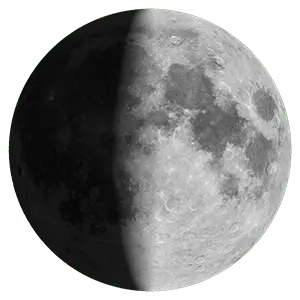
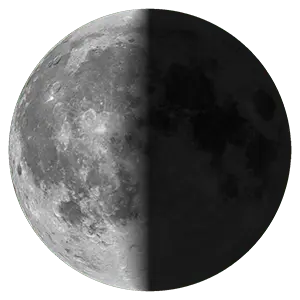
Текущая фаза Луны на сегодня и эту ночь — Растущая Луна. Луна сейчас освещена на 58.1 % и является растущая. Август 17, 2029Сегодня возраст Луны составляет 8.1 дней.
Приблизительное расстояние от Земли до Луны составляет 373,182, и до следующей фазы осталось 6.6 дней — (Полнолуние).
Посетите также Август 2029 Календарь фаз Луны, чтобы увидеть все ежедневные фазы Луны в этом месяце.

Фаза Луны: Растущая Луна
Предыдущая фаза: Первая четверть ()
Расстояние до Луны: 373,182 km
Освещённость: 58.1 %
Возраст Луны: 8.1 дн.
Следующая фаза: Полнолуние ()
Угловой размер Луны: 0.53
Расстояние до Солнца: 151,453,979 km
Знак зодиака Луны: Стрелец

2029-08-10 – 2029-09-08
| Фаза Луны | ДАТА И ВРЕМЯ |
ДАТА И ВРЕМЯ (UTC) |
|---|---|---|
| Новолуние | ||
| Первая четверть | ||
| Полнолуние | ||
| Последняя четверть | ||
| Новолуние |
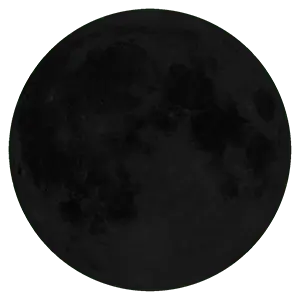
Это первая и невидимая фаза Луны: освещённая сторона Луны обращена к Солнцу, а ночная — к Земле. Новолуние видно напрямую только во время солнечного затмения.
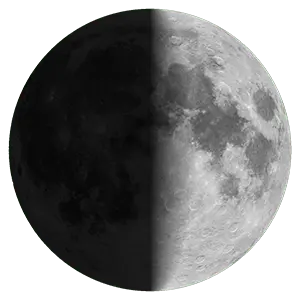
Первая четверть
Через неделю после новолуния наступает первая четверть, когда Луна проходит четверть своей орбиты. Эту фазу также называют полумесяцем. Луна в первой четверти восходит около полудня и заходит около полуночи.
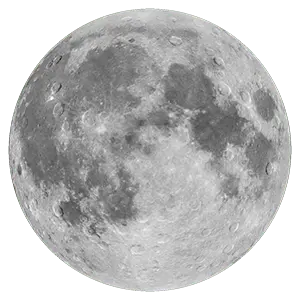
Полнолуние
При 100 % освещённости дневная сторона Луны обращена прямо к ночной стороне Земли, и Луна полная. Полнолуние восходит на закате и заходит на рассвете, а у горизонта кажется крупнее.
Последняя четверть
Луна входит в последнюю (третью) четверть своей орбиты в возрасте почти 23 дней. Освещённой кажется лишь половина. Эту фазу видно поздней ночью и ранним утром (около 6 утра).
The Moon makes Earth a more livable planet by moderating our home planet's wobble on its axis, leading to a relatively stable climate.
Подробнее Факты о ЛунеNo, it doesn’t generate its own light. “Moonlight” is really sunlight that has reflected off of the Moon’s surface. In the same way that the Sun illuminates Earth, the Moon reflects the Sun's light, making it appear bright in our sky.
Подробнее Факты о ЛунеA "micromoon" is a term used in popular astronomy to describe a full moon or a new moon that occurs when the moon is at or near its apogee, which is the furthest point from Earth in its elliptical orbit. This is the opposite of a "supermoon," which occurs when a full moon or new moon is at or near its perigee, which is the closest point to Earth in its orbit."
Подробнее Факты о ЛунеAn analysis of moon's mineral composition suggests that the moon is around 4.425 billion years old.
Подробнее Факты о ЛунеA supermoon occurs when the Moon's orbit is closest (perigee) to Earth at the same time the Moon is full. At such a time, the Moon can look larger and brighter than it normally does - especially when it is seen rising above the horizon. However, it's important to note that the actual difference in size and brightness between a supermoon and an average full moon is not typically dramatic, and may not be noticeable to the naked eye without a direct comparison.
Подробнее Факты о ЛунеAn orange moon means the shorter wavelengths of light are being filtered away. This could be due to the low position on the horizon causing the light to go through more atmosphere, smoke in the air, or pollution.
Подробнее Фазы ЛуныNo, the moon has no water and has only a very thin and tenuous atmosphere (called an exosphere) so it cannot trap heat or insulate the surface. So, for example, there is no wind to create weather system. The Moon does, in fact, affect the Earth's climate and weather patterns in several subtle ways.
Подробнее Фазы ЛуныAn analysis of moon's mineral composition suggests that the moon is around 4.425 billion years old.
Подробнее Фазы ЛуныNo, it doesn’t generate its own light. “Moonlight” is really sunlight that has reflected off of the Moon’s surface. In the same way that the Sun illuminates Earth, the Moon reflects the Sun's light, making it appear bright in our sky.
Подробнее Фазы ЛуныThis is an optical illusion. The Moon looks large shortly after it rises when it's still touching the horizon. This is not the same as a Supermoon.
Подробнее Фазы ЛуныAn orange moon means the shorter wavelengths of light are being filtered away. This could be due to the low position on the horizon causing the light to go through more atmosphere, smoke in the air, or pollution.
Подробнее ИнтересноеThe Moon makes Earth a more livable planet by moderating our home planet's wobble on its axis, leading to a relatively stable climate.
Подробнее ИнтересноеHere are the top 5 things that make the Moon so unique.
1. The Moon is Earth's only permanent natural satellite.
2. Moon dust smells like gunpowder.
3. The Moon keeps the same face pointing toward the Earth.
4. The Moon has no – or just a really thin – atmosphere so there is no weather.
5. The Moon is visible in daylight nearly every day.
A supermoon occurs when the Moon's orbit is closest (perigee) to Earth at the same time the Moon is full. At such a time, the Moon can look larger and brighter than it normally does - especially when it is seen rising above the horizon. However, it's important to note that the actual difference in size and brightness between a supermoon and an average full moon is not typically dramatic, and may not be noticeable to the naked eye without a direct comparison.
Подробнее ИнтересноеThe Moon crust is made of composed primarily of oxygen (O), silicon (Si), magnesium (Mg), iron (Fe), calcium (Ca), and aluminum (Al), but important minor and trace elements such as titanium (Ti), uranium (U), thorium (Th), potassium (K), and hydrogen (H) are present as well. Below the crust is the mantle coming, with a thickness of roughly 1350 km is far more extensive than the crust, which has an average thickness of about 50 km. The mantle is made of olivine, orthopyroxene and clino pyroxene. Finally, at the center is the Moon’s dense, metallic core. The core is largely composed of iron (Fe) and some nickel (Ni). The inner core is a solid mass of about 480 km in diameter. Surrounding the solid inner core is a fluid outer core, that brings the total diameter of the core to about 660 km.
Подробнее Интересное





MoonPhaseToday.org позволяет узнать фазу Луны на сегодня и эту ночь, а также на любой день, месяц и год. Расчёт фазы Луны основан на вашем часовом поясе, но мы также показываем точное время в формате UTC. Надеемся, наш инструмент будет полезным и удобным для определения фаз Луны.
MoonPhaseToday.org